Journal · · updated · 4 min read
The tinned fish fashion, and where French vintage sardines fit in
Tinned fish is in fashion, but quality varies widely. French vintage sardines stand apart by being dated by year, packed in olive oil and made to be kept, a matter of taste rather than of status.
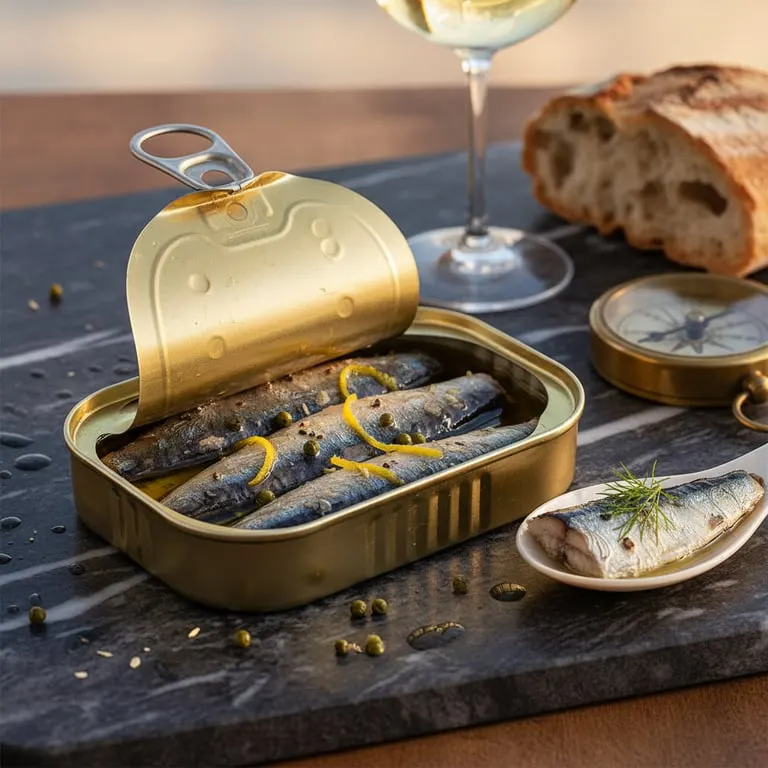
A few years ago, a tin of fish was what you ate when there was nothing else in the cupboard. Today it is served on boards in wine bars, sold in specialist shops with the tins lined up like books, and photographed as carefully as a bottle of wine. Tinned fish, or conserves, has become fashionable well beyond the countries that never stopped loving it.
That fashion has a downside: the shelf is now crowded, prices vary wildly, and good packaging is not the same as good fish. This guide sets out what makes French vintage sardines a distinct thing within the wider trend, and how to make the most of one.
A long tradition, newly fashionable
The enthusiasm is new in some places, but the craft is old. Portugal and Spain have long served tinned fish as an aperitivo, in bars and at home, with sardines, mackerel, octopus, mussels and anchovies in endless styles. France, and Brittany above all, has been canning sardines since the nineteenth century, with ports such as Douarnenez, Concarneau and Quiberon built around the trade, and Saint-Gilles-Croix-de-Vie on the Vendée coast.
What the fashion has added is attention: to the house that made the tin, to the oil, to the fish count, to the artwork. That attention is welcome, because it rewards the canneries that work carefully.
What makes a French vintage sardine different
Most tinned sardines are made to be eaten within their best-before date, and they are good from the day they are packed. A vintage sardine, sardine millésimée, is made with time in mind. Four features set it apart:
- It is dated by year. The year on the tin is the year of canning. Fish from one season go into one vintage.
- It is chosen for keeping. Makers select fish from the richest part of the season, as explained in fat content and the vintage sardine.
- It is packed in good oil. Usually extra virgin olive oil, which slowly exchanges flavour with the fish.
- It is meant to change. Makers advise keeping the tins and turning them every few months. Over several years the flesh softens and the flavour deepens.
None of this makes a vintage sardine "better" than a fine Portuguese or Spanish tin. It makes it different: closer, in spirit, to a cheese or a wine you choose to keep. For a side-by-side look, see aged sardines in France and Portugal.
How to read a tin
The packaging tells you more than it seems to.
| On the tin | What it means |
|---|---|
| A year, and millésime or millésimée | The year of canning; a tin chosen for keeping |
| À l'ancienne | Prepared the traditional way, usually by hand |
| A fish count, for example 9 to 10 | Smaller sardines; fewer means larger fish |
| The oil | Extra virgin olive oil is the classic choice for ageing |
| The best-before date (DDM) | A quality date, not a use-by date |
| The town of the cannery | Often the port where the fish was landed |
Flavoured tins, with tomato, chilli, lemon or herbs, are a different pleasure. They are best eaten young: the added ingredients do not improve with time the way oil and fish do.
Serving a vintage sardine as an appetiser
The fashion for elaborate boards can bury a good tin. A vintage sardine needs very little:
- Let the tin come to room temperature. Cold oil turns cloudy and mutes the flavour.
- Open it shortly before serving and lift the fish out whole, with a little of its oil.
- Add bread and, if you like, butter. Good bread is enough. In Brittany, salted butter is the classic partner, as described in sardines with butter and Guérande salt.
- Go easy on acidity. A squeeze of lemon suits a young tin; an old one is better without.
- Choose a crisp white wine, a dry cider or simply water. More ideas are in the wine pairing guide.
Do not cook it. Heat undoes the slow work of the tin, as explained in cooking sardines versus tasting them.
Tins kept for their art
Part of the fashion is visual. Several French houses dress each vintage in a new artwork: La Perle des Dieux commissions artists for its vintages, Pointe de Penmarc'h asks a Breton artist each year, and La Quiberonnaise marked its centenary in 2021 with tins drawn by comic artists. People keep them for the picture as much as for the fish. That is a perfectly good reason to keep a tin, and it has nothing to do with money: a tin's worth is in the eating and the looking.
Beyond the trend
Trends move on. What lasts is the simple pleasure of a well-made tin opened at the right moment. If you want to see what French vintage tins look like across several houses and years, the collection presented on this site gathers 511 tins from seven Breton and Vendée canneries, canned between 2016 and 2022. For more on the subject, the journal collects every article.
From the collection
Marianne Larvol · 5 tins · Shelf I
Gilbert Shelton · 10 tins · Shelf I
Chiporev · 2 tins · Shelf I