Journal · · updated · 4 min read
France or Portugal? Two ways with tinned sardines
France and Portugal can the same species, Sardina pilchardus, with different habits. Portugal is known for its wide range of styles and flavours to enjoy now; France is best known for dated tins in olive oil made to be kept. Choose by the moment, not by flag.
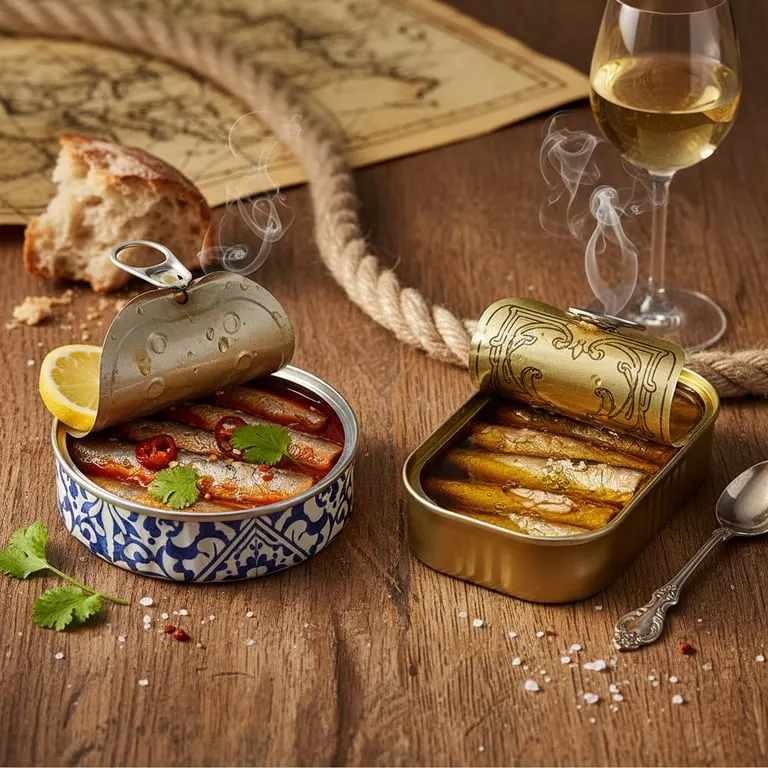
It is often presented as a rivalry: sunny Portuguese sardines against patient French ones. In truth there is no contest to win. Both countries can the same fish, both have long canning traditions, and both make excellent tins. What differs is habit: what each tradition tends to put in the tin, and what it expects you to do with it.
The same fish
In the European Union, only one species may be sold simply as "sardines": Sardina pilchardus, the European sardine. It swims along the Atlantic coasts of Portugal, Spain and France and into the Mediterranean. A sardine tinned in Matosinhos and one tinned in Douarnenez are the same species. The differences come from the season, the size of the fish, how it is prepared, the oil and, for some tins, time.
Portugal: range and generosity
Portugal has one of the richest tinned-fish cultures in Europe. Lisbon and Porto have shops devoted entirely to conservas, and the shelves show what the tradition values: variety. Alongside sardines in olive oil you will find sardines with tomato, with chilli, with lemon, with herbs, smoked, in spiced sauces, and in every size from tiny to large.
Well-known names include Ramirez, Pinhais (maker of Nuri) and many smaller houses. The tins are usually made to be opened and enjoyed fairly soon: with bread, with a glass, at the start of a meal shared with friends. The flavour is direct and the flesh firm.
That is a broad picture, not a rule. Portuguese canneries also make plain sardines in olive oil, and a good plain tin keeps well whatever its origin.
France: the habit of keeping
French canneries, mostly in Brittany and the Vendée, also make a wide range, from everyday tins to flavoured recipes. What France is best known for among enthusiasts is the vintage sardine, sardine millésimée: fish canned in season, in olive oil, with the year printed on the tin, intended to be kept.
Over time in the oil, the flesh softens, the bones become tender, and the taste grows rounder. Makers give advice on keeping. David Lebovitz, in his post on Rödel sardines, describes a 2013 tin from that house, which traces itself to 1824. The sardines were good to eat at once, he writes, but would grow softer and more confit in the oil, and the makers advised that they could be kept up to ten years. La Perle des Dieux, at Saint-Gilles-Croix-de-Vie, advises turning its vintage tins every six months.
Dated tins are not a French monopoly either. Spanish houses make them too: a Bordeaux tinned-fish shop, La Nouvelle Vague, lists small 2013 vintage sardines from Real Conservera Española among its vintage tins.
The two habits side by side
| Typical Portuguese tin | Typical French vintage tin | |
|---|---|---|
| Intention | To enjoy now | To keep, then enjoy |
| Oil and seasoning | Olive oil, often with tomato, chilli, lemon or herbs | Plain olive oil, little or nothing added |
| Texture | Firm, whole fish | Softer with age, bones tender |
| Flavour | Direct, bright, seasoned | Rounder, gentler, more integrated with the oil |
| Best served | With friends, as a snack or starter | Slowly, on bread, side by side with other years |
Remember that this table describes tendencies. A Portuguese sardine in good olive oil may keep beautifully; a French recipe tin with lemon and chilli is made to be eaten, not aged.
Which to choose
Choose by the moment.
- For a lively table, a mix of Portuguese tins in different sauces is hard to beat. Open several, put out bread, and let everyone try.
- For a quiet tasting, a French vintage tin, ideally two years of the same house, shows what time does to a sardine.
- For cooking, everyday tins from either country are perfect. A long-kept vintage is better eaten plain.
Neither tradition is "better". One is about range and immediacy, the other about patience. Many lovers of tinned fish keep both in the cupboard.
A tasting to settle the question at home
If you want to form your own view, try this:
- Buy a plain Portuguese sardine in olive oil and a French vintage tin at least two or three years old.
- Open both at room temperature.
- Taste each on its own, then on plain bread.
- Compare texture first, then the oil, then the length of the flavour.
You will probably find you like both, for different reasons.
Further reading
For the French side in more depth, read The ten-year-old sardine: grail or myth? and Vintage sardines: marketing fiction or real craft?. The collection presented on this site is entirely French, from seven Breton and Vendée canneries, 2016 to 2022.
From the collection
Marianne Larvol · 5 tins · Shelf I
Chiporev · 2 tins · Shelf I
Gilbert Shelton · 10 tins · Shelf I