Journal · · updated · 4 min read
The ten-year-old sardine: grail or myth?
A ten-year-old sardine is neither a myth nor a grail. Some makers say their vintage tins can be kept that long, and time does soften the fish, but older is not automatically better: when to open is a matter of taste.
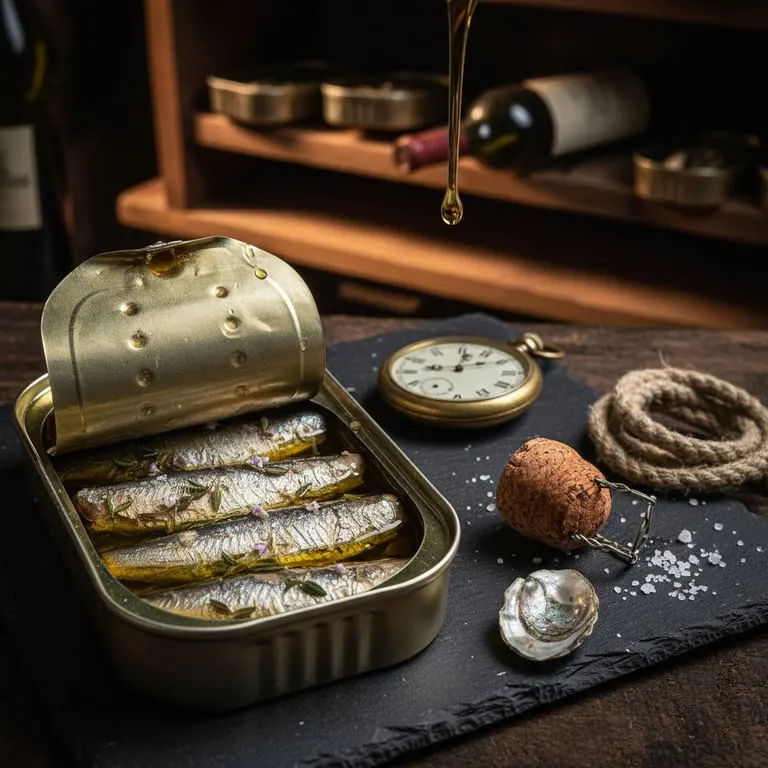
The ten-year-old sardine has become a small legend among lovers of tinned fish. You hear of tins kept for a decade, opened with ceremony, the fish so soft it melts. Is that the summit of the art, or a story that has grown in the telling? The answer is less dramatic and more useful than either.
Where the ten years come from
The figure is not invented. Some makers of vintage sardines say plainly that their tins can be kept that long.
- Rödel. David Lebovitz, describing a 2013 Rödel tin in his post on the house, notes that the sardines would become softer and more confit with time, and that the makers advised you could wait up to ten years before eating them. He admits he did not wait. Rödel's own site describes its classic vintage as a sardine whose taste may be preserved and enjoyed "even after ten years".
- La Perle des Dieux. The Saint-Gilles-Croix-de-Vie cannery describes the sardines of its 2020 vintage, Le Ballet enchanté de Mlle Lulu, as above 12% fat and made to age up to ten years, turned regularly.
So ten years is a maker's statement of what a well-made tin can withstand. It is a ceiling, not a target.
What time does to a sardine
A vintage sardine is canned in season, usually in olive oil, and left to rest. Over the years, several things happen slowly:
- The flesh softens. It moves from firm to tender, then to something close to melting.
- The bones become tender. The fine bones, and eventually the spine, soften until you barely notice them.
- Fish and oil merge. The oil takes on the taste of the fish, and the fish the roundness of the oil.
- The flavour rounds. The bright, briny taste of a young tin becomes gentler and longer.
These changes are why people keep tins at all. They are also why there is no single right moment. A tin at three years and the same tin at eight are different things, not a worse and a better version.
The risks of a long wait
Time is not only kind. Past a certain point, some tasters find the flesh too soft, almost pasty, and the flavour flatter. Much depends on how the tin was made and how it was stored. A tin kept in a warm kitchen for ten years will not resemble one kept in a cool, steady cellar and turned regularly.
The condition of the tin matters most of all. A tin that is swollen, leaking or deeply rusted should not be opened for eating, whatever its age. Our guide to reading an old tin explains what to look for.
What the date on the tin means
The date printed on a sardine tin is a best-before date, à consommer de préférence avant or DDM in French. It is a quality date, not a safety limit. After it, the maker no longer vouches for the quality, but an intact tin is not suddenly unsafe. Makers of vintage sardines expect their tins to be opened long after that date; that is the point of the genre.
This is different from a use-by date, which is a safety limit and applies to fresh, perishable foods rather than to tins.
So when should you open?
Makers' advice varies, and it is the best guide you have.
| Advice from the maker | Example |
|---|---|
| Wait a few years | La Perle des Dieux suggests waiting three to four years for its 2021 Le Grand Nicolas tin |
| Turn regularly | La Perle des Dieux advises turning its vintage tins every six months |
| Can be kept a long time | Rödel and La Perle des Dieux both mention up to ten years for some tins |
Beyond that, it is a matter of taste. If you like firm fish and a bright taste of the sea, open younger. If you love the soft, melting texture, wait longer. The best way to know is to buy several tins of one year and open them at intervals. Our guide to vertical tastings shows how.
Grail or myth?
Neither. The ten-year-old sardine is real, and opening one is a memorable experience, especially shared with people who have never tasted anything like it. But it is not the summit of quality, and age on its own is not a reason to pay more or to wait longer than you want to. A five-year-old tin you open with friends is worth more than a ten-year-old tin you never get round to.
For a sense of scale: the oldest dated tins in the collection presented on this site were canned in 2016, for the Festival des Filets Bleus at Concarneau, which makes them ten years old in 2026. They are listed, like every edition, in the register.
To go further, read Vintage sardines: marketing fiction or real craft? and our guide to opening, keeping or waiting.
From the collection
Gilbert Shelton · 10 tins · Shelf I
Marianne Larvol · 5 tins · Shelf I
Chiporev · 2 tins · Shelf I