Journal · · updated · 3 min read
Sardines, butter and Guérande salt: a Breton pairing explained
Butter preserved sardines on the Loire before olive oil replaced it in the first tins. Today butter sardines are recipe tins to warm and eat, while the classic Breton way is a vintage sardine in olive oil on bread with salted butter and a pinch of Guérande salt.
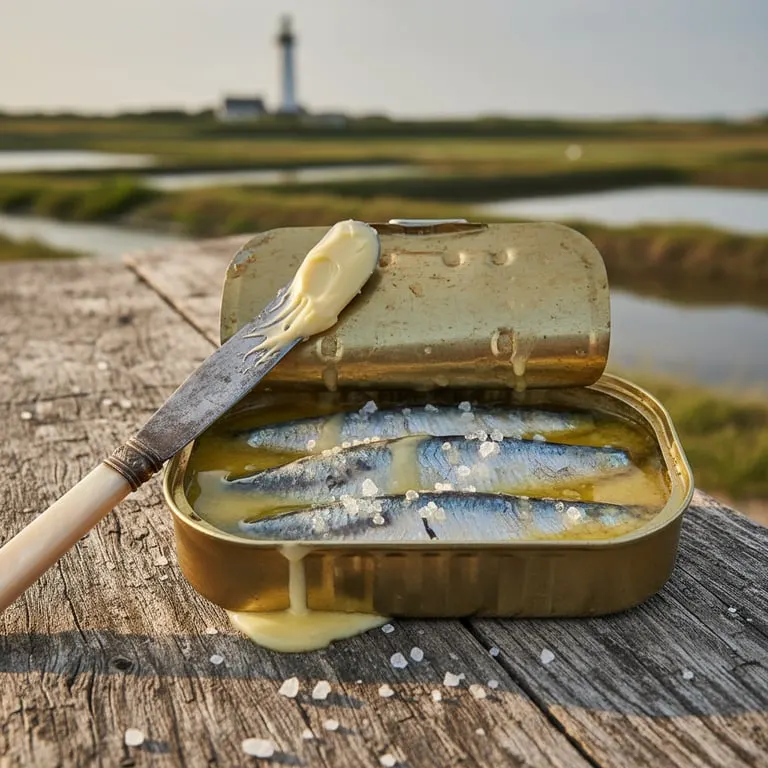
Most people picture a vintage sardine in olive oil, and rightly so. Yet anyone who has eaten sardines in Brittany knows that butter is never far away. The pairing of sardine, salted butter and sea salt is one of the simplest and best things the Breton coast offers. It is worth understanding where it comes from, and what it is not.
Butter came first
Before sardines were canned, they were preserved in other ways. A short history published by the French association Goût, Saveur et Tradition recalls that from the Middle Ages the mouth of the Loire was known for preserving sardines, cooked and kept in vinegar or in melted butter. When canning arrived in the early nineteenth century, a Nantes confectioner, Joseph Colin, adapted Nicolas Appert's method to sardines and replaced the melted butter with good olive oil.
So butter is not a modern fancy. It belongs to the older layer of the story, from a coast rich in dairy and short of olive trees. Olive oil won in the tin because it keeps the fish well and lets it change gently over years. Butter stayed on the table.
Butter in a tin today
You can still buy sardines in butter. They are recipe tins, not vintages. The Breton house Hénaff, for example, sells sardines in churned butter that it presents as a dish to be eaten warm, alongside a buckwheat and butter version. They are made to be heated in a pan and eaten, not kept for years.
That is the honest distinction. A vintage sardine is canned in olive oil and dated so that it can rest. A butter sardine is a ready dish. Both are good; they are simply made for different moments.
The table version: bread, butter, sardine
The most common Breton pairing has nothing to do with a butter tin. It is a vintage or good-quality sardine in olive oil, laid on bread spread with salted butter.
David Lebovitz, writing about Rödel sardines on his site, describes much the same lunch: a good dark or grainy loaf, a generous layer of salted butter, the sardines, and a glass of dry white wine. He adds little else, perhaps some parsley or chives.
Why it works is easy to taste:
- Fat meets fat. The cool, firm butter contrasts with the soft, oily fish.
- Salt lifts both. Salted butter seasons the bread, so the sardine does not need more.
- Texture. Crust, cold butter and tender fish make one mouthful with three textures.
Where Guérande salt comes in
Guérande salt is raked by hand from the salt marshes of the Guérande peninsula, on the Atlantic coast near the mouth of the Loire. Its finest form, fleur de sel, is the delicate layer of crystals skimmed from the surface of the pans. It is moist, crunchy and gentle rather than sharp.
A sardine from a tin is already seasoned, so salt should be used with care. The best place for a few grains of fleur de sel is on the butter, not on the fish. If you use unsalted butter, a small pinch is enough to give each bite a little crunch.
How to serve it
- Bring the tin to room temperature. Cold oil tastes flat and the flesh stays firm.
- Choose the bread. A country loaf, a slice of rye, or a thin buckwheat galette, warmed.
- Spread the butter thickly, salted Breton butter if you have it.
- Lift the sardines out whole with a fork and lay them on the bread. Keep the oil; a spoonful over the top is welcome.
- Finish with a few grains of fleur de sel on any bare butter, and herbs if you like.
For a warm version, open a butter sardine tin, heat it gently in a pan, and serve it on boiled potatoes or a buckwheat galette.
What to drink
Something dry, fresh and from the same coast works best: a Muscadet, a dry Loire Chenin, a dry Breton cider, or a cold beer. Our wine pairing guide goes further.
Keeping and eating
If you are building a small store of tins, keep the two kinds apart in your mind. Vintage tins in olive oil can wait, turned every few months. Recipe tins, butter ones included, are best eaten within their best-before date. The collection presented on this site follows the same logic: its Lot III, the recipe tins, is described plainly as made to enjoy, not to keep.
To understand why a plain vintage tin rewards simple serving, read The Niçoise temptation: why a vintage sardine is best served plain.
From the collection
Gilbert Shelton · 10 tins · Shelf I
Chiporev · 2 tins · Shelf I