Journal · · updated · 4 min read
Seine or trawl: how the fishing method shapes a sardine for the tin
Most Breton and Vendée sardines for canning come from small purse seiners. What matters for a tin meant to age is less the gear's name than how gently the fish are handled and how fast they reach the cannery.
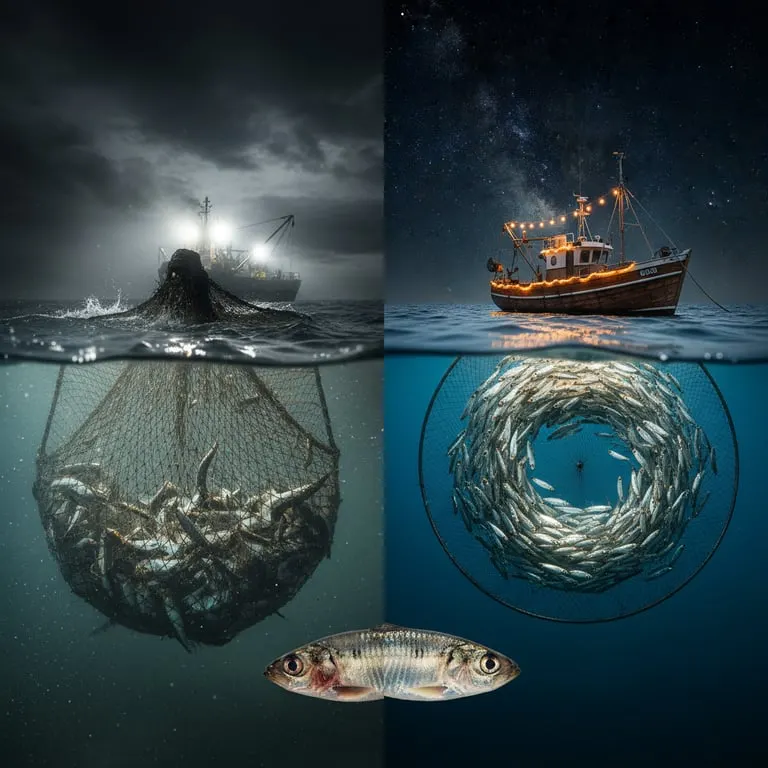
A sardine destined for a tin that will be kept for years starts its life as a fish in a net. How it got there, how long it was crowded, how it came aboard and how quickly it reached the cannery all leave marks on the flesh. None of this is printed on the lid, which is why it is worth understanding.
The two main ways sardines are caught
Off the Atlantic coast of France, sardines are caught mainly in two ways.
The purse seine, or bolinche
A purse seine is a long wall of net set in a circle around a shoal near the surface. Once the circle is closed, a line along the bottom is drawn in like the string of a purse, and the net is slowly hauled until the fish are gathered alongside the boat, then brought aboard.
Along the south coast of Brittany and in Vendée, much of the sardine catch comes from small purse seiners, known locally as bolincheurs. They work close to the coast, often at dusk, at night or at dawn, when sardine shoals rise towards the surface. Trips are short, so the fish are landed within hours.
The pelagic trawl
A pelagic trawl is a cone-shaped net towed through the water, sometimes by two boats working as a pair. It does not touch the seabed, but it sweeps up whatever swims in its path. Fish accumulate at the narrow end of the net, where the weight of the catch presses on those at the bottom, until it is hauled.
Trawlers can cover more water and catch large volumes, and they play their part in the Bay of Biscay fishery. They have also been at the centre of concern about accidental catches of common dolphins in the Bay of Biscay, which led France to close several fisheries there for some weeks in the winter of 2024.
Why handling matters for a tin meant to age
A sardine is a small, soft, oily fish. It loses scales easily, bruises easily, and spoils quickly once out of the water. Seafood scientists and fishers agree on a few general points:
- Crushing marks the flesh. Fish pressed under the weight of a large catch can be bruised or split, and the damage shows once they are cooked and packed.
- Exhaustion changes the flesh. A fish that struggles for a long time before it dies uses up the energy stored in its muscle. It stiffens sooner after death and its flesh tends to be softer and less fine.
- Warmth is the enemy. Every hour a sardine spends unchilled shortens its quality life. Fast icing and a short trip to port matter as much as the net.
Neither gear is gentle in any absolute sense. A purse seine can crowd fish badly if it is dried up too hard, and a short, careful trawl can land good fish. What separates a fine sardine from an ordinary one is the whole chain: how long the fish are crowded, how they come aboard, how quickly they are chilled, and how soon they reach the cannery.
For an everyday tin, small differences may not show. For a vintage tin, they matter more. The flesh will spend years in oil, and a fish that went in damaged or tired will not come out better. A bruise does not heal in a tin.
From the boat to the cannery
The canneries that make vintage sardines put the emphasis on freshness:
- La Quiberonnaise says its sardines are prepared and packed by hand within 48 hours of being caught, and that it buys as close to the Quiberon coast as it can.
- La Perle des Dieux, at Saint-Gilles-Croix-de-Vie, says its sardines are caught locally and packed fresh at the cannery near the port. Saint-Gilles-Croix-de-Vie holds the Site Remarquable du Goût label for its sardines.
- Connétable says its Label Rouge sardines carry the name of the boat and the fishing date on the tin.
Fresh, never frozen, is the usual rule for tins meant to age. Freezing before canning is common and perfectly safe for ordinary tins, but it changes the texture of a fish this delicate.
What a label can and cannot tell you
Most tins do not say how the fish was caught. A few things on the packaging help:
- A port or a coast of catch. A cannery buying at its own port is usually working with local seiners.
- A boat name and a date, on some Label Rouge tins. That is as close to full traceability as a sardine tin gets.
- Fishery certification. Some ranges carry the blue MSC logo, which certifies the fishery's management, not the handling of each catch.
- The cannery's own account. Most houses explain on their websites where and how they buy. If they do not, it is fair to ask.
Why the sea comes first
It is tempting to think a vintage sardine is made in the cannery and the cellar. In truth the cannery can only keep what the boat delivers. A fat, well-handled, quickly landed fish has everything a tin needs to improve with time; a tired or damaged one does not. That is part of what people mean by the maritime terroir of a sardine, and why the season matters as much as the gear, as explained in fat content and the vintage sardine.
For a broader look at regional origin marks, see the Produit en Bretagne label. To see which ports and houses the dated tins in the collection come from, each edition lists its cannery and town.
From the collection
Marianne Larvol · 5 tins · Shelf I
Chiporev · 2 tins · Shelf I