Journal · · updated · 3 min read
Beyond taste: what the 'Produit en Bretagne' label tells you about a sardine tin
Produit en Bretagne says a product is made in Brittany by a member of a regional business network; the EPV label recognises rare craft or industrial know-how. Both are useful signs of origin and skill, but neither grades taste, vintage or storage.
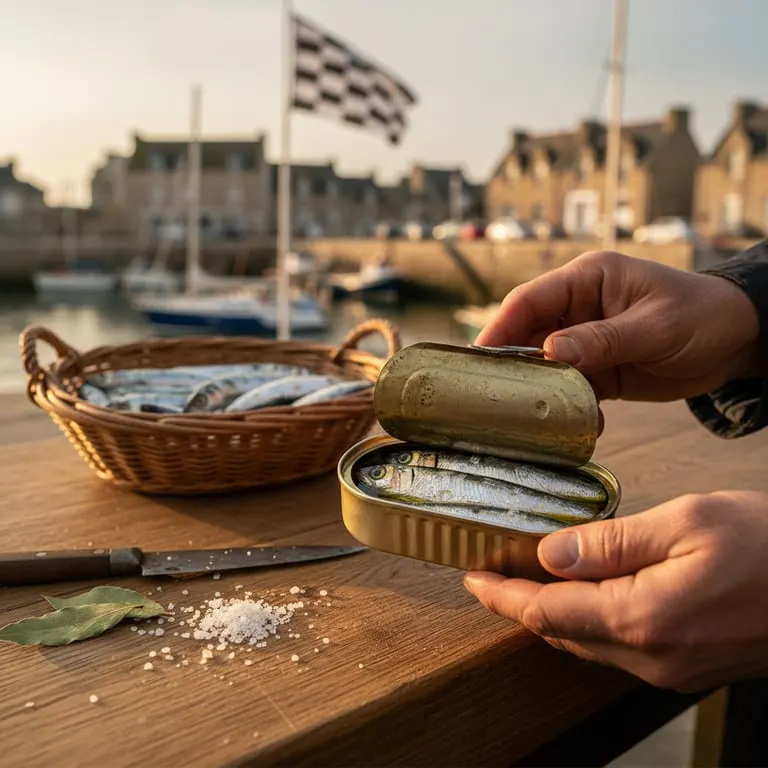
Labels on food can mean a great deal or very little. On a tin of sardines from Brittany you may see two that matter: the Produit en Bretagne logo and the EPV label, Entreprise du Patrimoine Vivant. Both are real and both tell you something useful. Neither tells you everything, and it helps to know the difference.
A recent example: La Quiberonnaise
La Quiberonnaise is a cannery on the Quiberon peninsula, in the Morbihan. According to its own account, it was founded in 1921 by Henriette Jourdan, specialises in sardines, works only with fresh fish, and prepares and packs its sardines by hand within 48 hours of their being caught. The cannery says it respects the fishing seasons and sources as close as possible to the Quiberon coast.
The same page states that La Quiberonnaise is certified as an Entreprise du Patrimoine Vivant and that it joined the Produit en Bretagne network in 2024. The cannery appears among the members listed by Produit en Bretagne.
It is a good case for understanding what each label means.
What Produit en Bretagne is
Produit en Bretagne is an association founded in 1993 by Breton businesses. It describes itself as the leading economic network in Brittany, with around five hundred member companies. Its logo appears on products made in Brittany by those members, across food, drink, household goods and more.
What the logo tells you:
- Where the product is made. The product comes from a member company working in Brittany.
- That the company has joined a regional network which promotes Breton production, jobs and local commitments.
What it does not tell you:
- How good the product tastes. It is not a tasting grade or a competition medal.
- How the fish was caught, or that it is a vintage, or how long it has been kept.
- Anything about a tin's life since it left the cannery: where it was stored, whether it was turned, whether it is in good condition.
It also helps to remember its geography. The network covers Brittany. Excellent canneries on the same coast but outside the region, such as those of Saint-Gilles-Croix-de-Vie in the Vendée, will not carry it, and that says nothing against their tins.
What the EPV label is
The Entreprise du Patrimoine Vivant label is a French state distinction, created in 2005, for companies that hold rare, traditional or high-level craft or industrial know-how. It is granted for a limited period and must then be renewed. Many of its holders are small workshops and family firms.
For a cannery, EPV suggests that the way the work is done, preparing fish by hand, packing each tin, keeping old methods alive, has been recognised as a skill worth preserving. It is a recognition of know-how, not a guarantee of each tin's taste. Our article on the EPV label and sardine know-how goes into more detail.
Reading labels alongside the tin
Labels are best used with the other things a tin tells you:
| Sign | What it tells you |
|---|---|
| The house and its town | Who canned it and where |
| The year | The season the fish was canned in |
| Produit en Bretagne | Made in Brittany by a member of the network |
| EPV | The company's know-how has been recognised by the state |
| The oil and method | How the fish was prepared and what it rests in |
| The best-before date (DDM) | A quality date, not a safety limit |
| The condition of the tin | Whether it has been well kept |
Taken together, these signs give a fair picture. Taken alone, any one of them can mislead.
Why this matters far from Brittany
For a buyer far from France, labels are helpful because they are verifiable. You can look up a member company on the Produit en Bretagne site, and you can read what a cannery says about its own methods. That is more solid than adjectives on a box.
But the most important checks remain the simple ones: a named house, a year, good oil, a sound tin, and a maker who explains how the fish was handled.
In the collection
The collection presented on this site includes La Quiberonnaise tins from before it joined the network: three 2021 centenary editions drawn by Gilbert Shelton, Franck Margerin and Pic, and a 2022 classic vintage of nine to ten small sardines. Each is listed in the register.
For a wider look at how origin shapes a sardine, read Maritime terroir: does the sea give a sardine its flavour? and Vintage sardines: marketing fiction or real craft?
From the collection
Gilbert Shelton · 10 tins · Shelf I
Chiporev · 2 tins · Shelf I