Journal · · updated · 4 min read
Beyond 'Made in France': what the EPV label means for a sardine cannery
The EPV label is awarded by the French State, for five years, to companies with rare or outstanding know-how. It certifies a cannery's skills, not a tin, and sits alongside origin marks rather than above them.
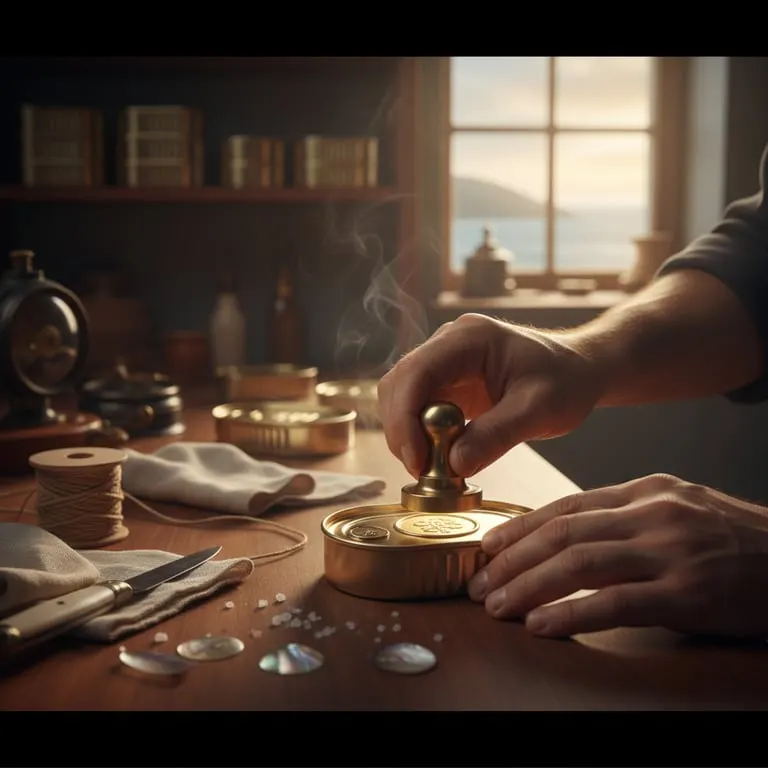
Turn a tin of sardines over and you may find several marks besides the brand: a region, a quality label, a fishery certificate, sometimes a small logo reading Entreprise du Patrimoine Vivant. That last one is the least known outside France and often the most misunderstood. It says nothing about where the fish came from. It says something about the people who prepared it.
What the EPV label is
Entreprise du Patrimoine Vivant, usually translated as Living Heritage Company, is a distinction created by the French State in 2005, under a law in support of small and medium-sized businesses. It is awarded to companies whose know-how is judged rare, of a high level, or rooted in a long tradition, and whose skills are kept and passed on in the workshop.
A few points are worth knowing:
- It is awarded for five years. A company has to apply again, and be reviewed again, to keep it.
- It covers every trade. Crystal, cutlery, furniture, textiles, printing, bell founding and food all sit side by side. Well over a thousand companies hold it.
- It rewards a company, not a product. The label is about skills and their transmission, not about a recipe or a single range.
What it certifies, and what it does not
Because the logo appears on packaging, it is easy to read more into it than it says.
| The EPV label tells you | The EPV label does not tell you |
|---|---|
| The company's know-how was examined and judged outstanding | Where the fish was caught |
| Skilled hand work is kept up and taught | That a given tin is a vintage |
| The company was reviewed within the last five years | How a tin will age, or how it tastes |
For sardines, the know-how in question is mostly the hand work that machines do badly with a small, fragile fish: sorting, cutting, and packing each sardine into the tin. That work is the subject of the Breton method behind houses like Connétable.
Sardine canneries that hold it
Several French canneries carry the label. Two of the houses represented in the collection presented on this site say so on their own websites.
La Quiberonnaise, founded in 1921 by Henriette Jourdan in the fishing port of Quiberon, states that it is certified as an Entreprise du Patrimoine Vivant. It also says that its sardines are prepared and packed by hand within 48 hours of being caught, and that it joined the Produit en Bretagne network in 2024. Its history page sets this out.
Gendreau, the cannery behind La Perle des Dieux at Saint-Gilles-Croix-de-Vie in Vendée, writes that its sardines have been sorted, cut and packed by hand for some 130 years, and that this canning know-how has received the Living Heritage label. The cannery opened in 1887, was bought by the Gendreau family in 1906, and created the La Perle des Dieux brand in 2005. The details are on the Groupe Gendreau page for La Perle des Dieux.
Other canneries may hold the label too. The reliable check is the maker's own site or the logo on the tin, read alongside the date it was awarded, since it has to be renewed.
EPV and Produit en Bretagne: two different questions
The two marks are often confused, and sometimes set against each other. They answer different questions.
- Produit en Bretagne is a network of Breton companies. Its logo tells you a product is made in Brittany by a member company. It is about origin and regional ties. It is covered in detail in the Produit en Bretagne label and sardine authenticity.
- EPV is a national distinction for know-how. It tells you how a company works, wherever in France it is.
Neither is "above" the other. A cannery can hold one, both or neither. La Quiberonnaise, by its own account, holds both: one says where, the other says how.
What the hand does in a sardine cannery
It helps to picture the work the label is rewarding. In a traditional cannery, fresh sardines arrive from the port and are sorted by size. They are headed and gutted, brined, cooked, then laid into the tin one by one. Packing is the most skilled step: the fish must fit snugly without being crushed, often all facing the same way, and in some houses all belly up, a presentation the trade calls au blanc. Then the oil goes in, the lid is seamed and the tins are sterilised.
Machines can do much of this, and large factories use them. The canneries that keep the hand work do so because sardines are soft and easily marked, and because a well-packed tin looks, keeps and tastes better.
How to use the label as a reader
The EPV logo is a good sign. It tells you that someone outside the company looked hard at how it works and found skills worth protecting. But it is one clue among several. For a tin meant for keeping, also look at:
- the year on the tin, and the word millésime;
- the oil, usually extra virgin olive oil for vintages;
- the season and the place of catch, when given;
- the maker's own advice on keeping and turning.
Taken together, those tell you far more than any single logo. To see dated tins from Breton and Vendée houses, including La Quiberonnaise and La Perle des Dieux, browse the collection.
From the collection
Chiporev · 2 tins · Shelf I
Gilbert Shelton · 10 tins · Shelf I