Journal · · updated · 4 min read
Twin affinage: pairing vintage sardines with aged cheese
An aged cheese and a vintage sardine both bring savoury depth, and glutamate from cheese with inosinate from fish strengthen each other. Choose firm, clean cheeses, keep portions small and taste them side by side.
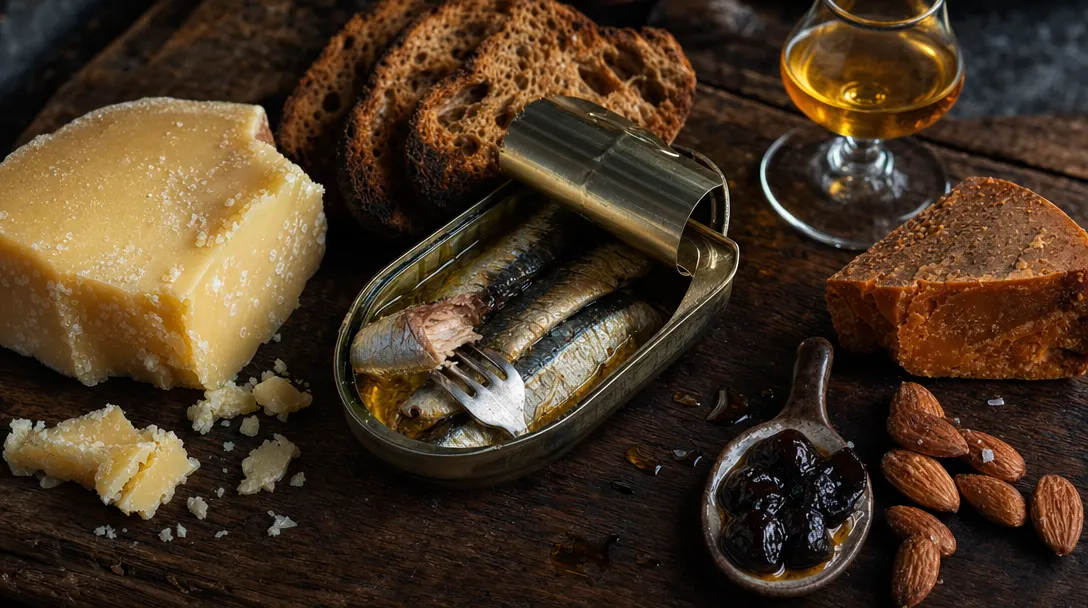
Fish and cheese have a poor reputation together. In Italian kitchens, parmesan on a seafood pasta is often frowned upon, and many cooks keep the two apart by instinct. Yet a vintage sardine and a piece of well-aged cheese, tasted side by side, can be very good company. Both are foods shaped by time, both are rich in savoury flavour, and the way their flavours combine has a simple explanation.
Two kinds of ageing, not one
It is tempting to say that a vintage sardine and an aged cheese age "in the same way". They do not, and the difference is worth knowing.
- An aged cheese is alive with enzymes and microbes. Over months, they break down proteins and fats, releasing free amino acids, glutamate among them, and building flavour. The crunchy white crystals in an old Comté or an aged Mimolette are clusters of the amino acid tyrosine, a sign of that breakdown.
- A vintage sardine is sterilised in its tin. The heat that makes it keep also stops most biological activity. What happens over the years is slower and gentler: the flesh softens, the bones melt further and fish and oil exchange flavour. There is no rind and no microbe at work.
So the two are not twins in their biology. They are cousins in their result: both end up with deep, rounded, savoury flavour, and both reward patience.
Why the flavours reinforce each other
The savoury taste known as umami comes mainly from glutamate and from certain nucleotides, notably inosinate and guanylate. Aged cheeses are rich in glutamate. Fish, sardines included, contain inosinate.
Food scientists have long known that glutamate and inosinate together taste much more savoury than either alone: the effect is not additive but multiplied. Japanese cooks use this principle in dashi, the stock made from kombu seaweed, rich in glutamate, and katsuobushi, dried bonito rich in inosinate.
A bite of sardine followed by a sliver of aged cheese plays on the same effect. That is why the pairing tastes fuller than either food on its own, and why small portions are enough.
Choosing the cheese
A few principles:
- Firm and clean. Pressed, cooked or uncooked hard cheeses work best. Their savoury depth meets the fish without overwhelming it.
- Not too pungent. Strong blue cheeses and very assertive washed rinds tend to bury the sardine.
- Not too fresh. Young, milky cheeses add little; the point is depth.
- Match intensity. A young tin calls for a gentler cheese, an older tin can stand a more mature one.
Three pairings to try
1. An older tin with an aged Comté and a glass of vin jaune
A Comté of two years or more, with its crystals and its notes of brown butter and nuts, sits well beside a sardine that has spent several years in olive oil. A small glass of vin jaune from the Jura, with its nutty, oxidative character, ties the two together.
Taste the cheese first, then the sardine on a little bread, then sip the wine.
2. A vintage in olive oil with aged Mimolette and toasted rye bread
Extra-aged Mimolette is hard, deep orange and almost caramel in flavour. Its firmness contrasts with the soft flesh of a vintage sardine, and toasted rye bread adds a slightly bitter, crisp base. Serve the bread warm, not hot.
3. A young tin with a Basque sheep's cheese and black cherry jam
For a gentler pairing, try a younger tin, firmer and brighter, with a sheep's milk cheese from the Basque country, served in the local way with black cherry jam. The jam adds a fruity counterpoint, the sheep's cheese a rich, smooth texture. Use the jam sparingly, on the cheese only.
Building a sea and milk board
For a few friends:
- Two or three tins, ideally of different ages from the same house, opened at room temperature just before serving.
- Three cheeses, arranged from mildest to strongest.
- Good bread, plain and toasted rye.
- A few extras: toasted almonds or walnuts, black cherry jam, a few cornichons for freshness.
Lay out the tins in the middle and the cheeses around them. Invite people to taste each tin on its own first, then with each cheese.
What to drink
Wines with good acidity and little tannin tend to suit both fish and cheese. Good choices include a dry white from the Loire or the Jura, a fino or manzanilla sherry, a mature Champagne or a dry cider. Avoid heavily oaked whites and tannic reds, which clash with oily fish. More ideas are in the wine pairing guide and in Muscadet with vintage sardines.
Time on both sides of the board
Comté, Mimolette and vintage sardines have one thing in common that matters more than chemistry: someone chose to wait. That waiting is what both sides of the board reward. To understand what the years do to the fish, read the melting bone and the science of umami in aged sardines. For another classic partner, see sardines with butter and Guérande salt.
From the collection
Chiporev · 2 tins · Shelf I
Gilbert Shelton · 10 tins · Shelf I
Marianne Larvol · 5 tins · Shelf I