Journal · · updated · 4 min read
Hunting for vintage sardines in Paris: a buyer's guide
In Paris, vintage sardines are found in fine grocers, department store food halls and the canneries' own shops. Read the house, the year, the oil and the method on the tin, check its condition, and ask how it has been stored.
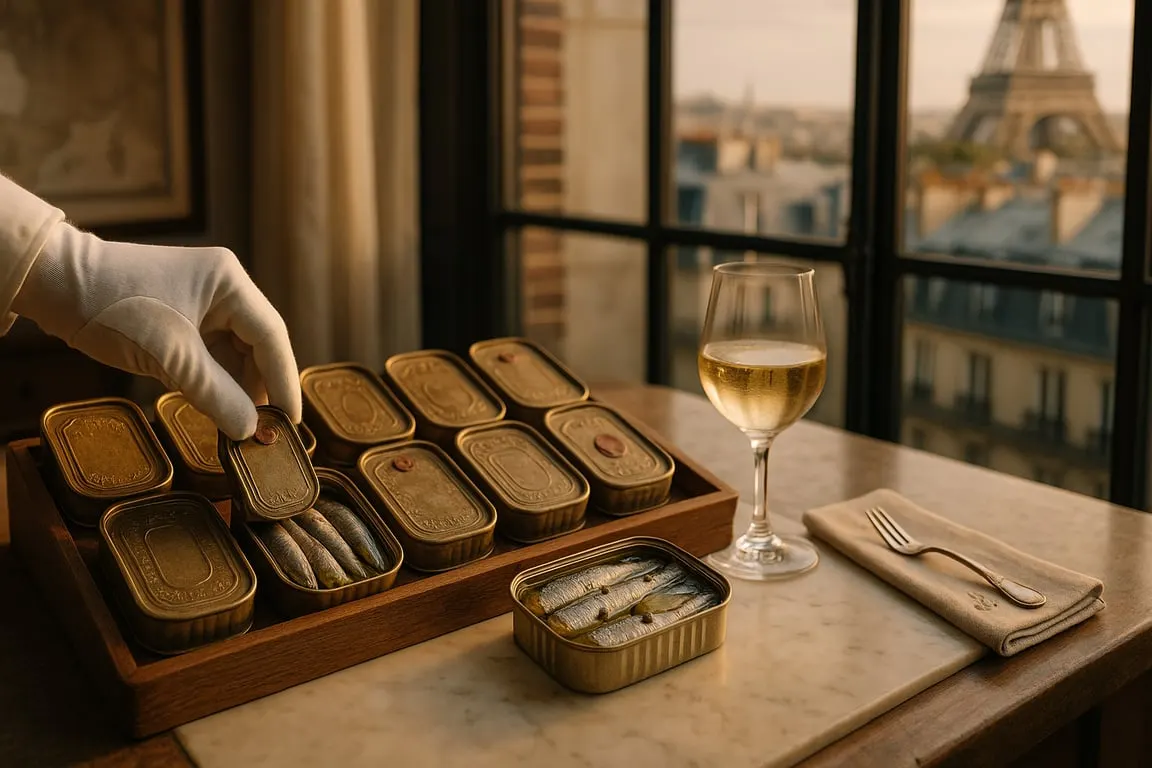
Paris is a good city for tinned fish. Many French canneries sell there, fine grocers keep a shelf of dated tins, and the food halls of the big department stores stock brands you rarely see elsewhere. It is also a city where you can easily pay a lot for a pretty tin without knowing much about what is inside. This guide is about finding the good ones.
Where vintage tins turn up
You will usually find vintage sardines in four kinds of place:
- Canneries' own shops. Several Breton houses run their own boutiques, in Brittany and in other French cities. La Belle-Iloise, the Quiberon cannery, is the best known; its website lists its shops. These are the places to find a house's current vintage and to ask about it directly.
- Department store food halls. The large Paris food halls carry premium tins from several houses.
- Fine grocers and fish specialists. Independent épiceries often stock smaller canneries and older years.
- Wine shops and wine bars. Some keep a few tins to serve with a glass.
David Lebovitz, the American pastry chef and writer who lives in Paris, described his own search for Rödel sardines in a post on his site. After tasting a tin in a wine bar in the Loire, he tracked them down at La Grande Épicerie, near the fresh seafood counter, and listed other Paris shops that carried good sardines at the time. Shops change their ranges, so treat any list as a lead to check rather than a promise.
What to read on the tin
Before price or packaging, read the tin itself. A good vintage tin answers most of these:
| On the tin | What it tells you |
|---|---|
| The house and its town | Who canned the fish, and roughly which coast it came from |
| The year | The season the fish was canned in |
| The oil | Extra virgin olive oil is usual for tins meant for keeping |
| The method | Words such as à l'ancienne, or a description of hand preparation |
| The number of fish or the size | Small sardines and large ones age differently |
| The best-before date (DDM) | A quality date, not a safety limit |
| Keeping advice | Some makers say how long to wait and how often to turn the tin |
A tin with a sauce, herbs or spices is usually a recipe tin. Recipe tins can be delicious, but they are made to be eaten, not kept for years.
Check the tin before you pay
Look at the tin as you would look at a bottle with an old cork. Turn it in your hand. It should be flat, clean and tight. Avoid tins that are swollen, leaking, deeply rusted or badly dented on a seam. Light surface marks on an old tin are common; a bulge is not acceptable. Our guide to reading an old tin goes into detail.
Paper wrappings and boxes are part of the charm, but they can hide the tin. If a shop will let you, look underneath.
Questions worth asking
A good shopkeeper will be happy to answer:
- When did this year arrive in the shop? A recent arrival has spent most of its life with the maker.
- Where has it been kept? A tin that sat in a sunny window through a Paris summer has not been well treated.
- Do you have several years from the same house? Buying two years side by side is the simplest way to start learning what time does.
- What does the maker advise? Some houses recommend waiting a few years; some say their tins can be kept for many.
Price, rarity and common sense
Prices of vintage tins vary a great deal, mostly with the house, the size of the fish and the packaging. A higher price does not mean an older or better tin, and an older tin is not necessarily better to eat. Buy what you will enjoy opening. A tin of sardines is food; its value is on the table.
Bringing tins home
Tins travel well. Keep them in your hold luggage or in a bag that will not sit in the sun, and once home store them somewhere cool and steady, away from heat. Many makers advise turning vintage tins every few months so that the oil covers the fish evenly.
A note for readers far from Paris
You do not need to be in Paris to find good vintage sardines: many canneries sell directly, and specialist tinned-fish shops exist in many cities. The point of the hunt is less the address than the habit of reading the tin.
The collection presented on this site is a single private collection, documented edition by edition in the register, with house, year, artist and quantity for each. To understand what to expect as a tin ages, read The ten-year-old sardine: grail or myth?, and for what to drink alongside, our wine pairing guide.
From the collection
Gilbert Shelton · 10 tins · Shelf I
Marianne Larvol · 5 tins · Shelf I
Chiporev · 2 tins · Shelf I