Journal · · updated · 4 min read
Who are the new sardinophiles? A portrait of the modern tin collector
Sardinophiles collect dated sardine tins for three main reasons: to taste them as they age, for the artists' lids, and for the memory of a place or a year. Their habits are simple: store cool, turn, note, open now and then.
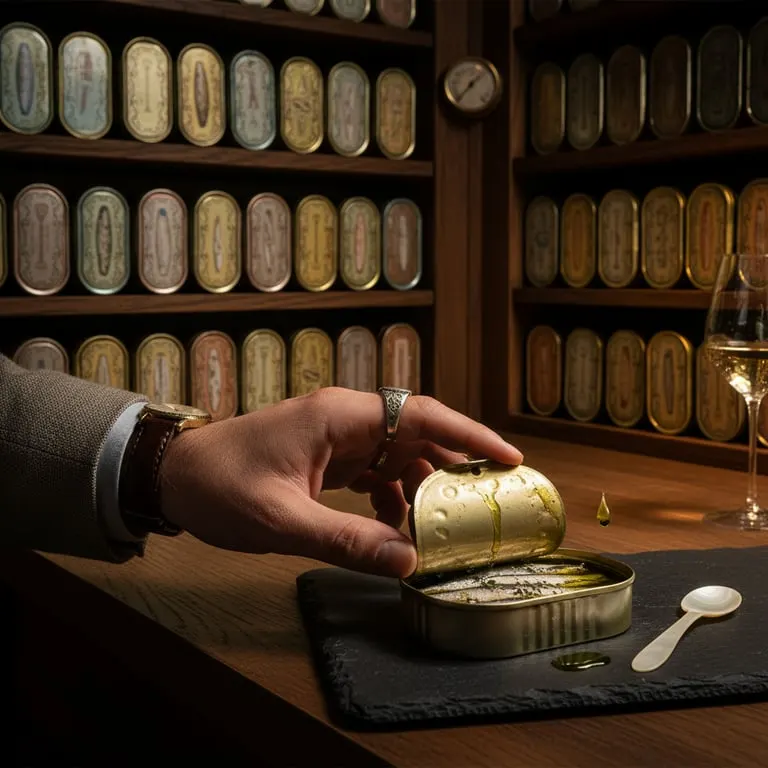
Collecting sardine tins sounds like a joke until you see a shelf of them. The lids are painted, the years are printed, the names of small ports run along the sides, and each tin holds something that changes slowly in the dark. It is not hard to understand why some people start keeping them.
This is a portrait of that collector, drawn from what the tins themselves show rather than from any survey. There is no single type, but three kinds of interest come up again and again, often in the same person.
The taster
The first kind of sardinophile collects in order to eat. Vintage sardines, canned in season and dated by year, are made to be kept: in olive oil and with time, the flesh softens, the bones become tender and the flavour grows rounder. The taster buys several tins of a year, opens one now and then, and follows the change.
What draws this collector is the same thing that draws people to cheese or wine: the pleasure of noticing how time works on a good product. A taster will happily open a five-year-old tin beside a one-year-old tin of the same house, just to see.
The lover of artists' lids
The second kind of collector comes for the art. Over the last decade, several French canneries have commissioned painters, illustrators and comic artists to decorate their vintage tins. A few examples from recent years:
- For its centenary in 2021, La Quiberonnaise, founded in Quiberon in 1921, asked comic artists to draw special tins, among them Gilbert Shelton, Franck Margerin and the cartoonist Pic.
- La Perle des Dieux, in Saint-Gilles-Croix-de-Vie, gives each vintage to an artist. Coralie Joulin of La Rochelle has painted its muse, Mademoiselle Lulu, at a carnival and at the Paris Opera; Justine Sage drew a fisherman watching over the reef with the Tour Joséphine lighthouse behind him.
- Pointe de Penmarc'h has illustrated its old-style vintages with Breton artists, including the painter and sculptor Fañch Moal and the marine painter Bruno Blouch.
For this collector, a tin is a small printed picture that happens to contain fish. Some keep one tin closed for the lid and one to open.
The keeper of a place or a year
The third kind collects memory. Some tins mark an event: Jean Burel Océane, a small Concarneau cannery, made collectors' tins for the Festival des Filets Bleus, the town's long-running summer festival. Others mark an anniversary, a centenary, or a collaboration, such as a 2021 vintage made by La Perle des Dieux with the French Navy.
People in this group often keep tins from their birth year, from a summer spent on a particular coast, or from a cannery they once visited. The tin becomes a souvenir with a date on it.
Habits that most sardinophiles share
Whatever the reason for collecting, the practical habits are much the same.
- Store tins cool and steady, in a cupboard or cellar away from heat, light and big swings in temperature.
- Turn them every few months. Makers commonly advise it; La Perle des Dieux, for one, suggests turning its vintage tins every six months so the oil keeps the fish evenly covered.
- Keep notes. House, year, artist, where it was bought, and when each tin was opened. A notebook is enough.
- Open one now and then. Tasting is the only way to know how a year is going, and the best way to share the hobby.
- Check the tins. A collection is food in storage. A bulging or leaking tin should be thrown away, and the signs of an old tin worth opening are worth learning.
What collecting is not
Collecting sardine tins is not a way to make money, and it is worth saying so plainly because some articles suggest otherwise. A tin of sardines is food. Its date is a best-before date, not a certificate. Whether an older tin is better is a matter of taste, and the pleasure of a collection lies in looking at it, sharing it and, sooner or later, eating it.
Nor is it a closed club. Sardinophiles are people who like good tinned fish, small canneries and nice lids, and who enjoy talking about them.
One collection, as an example
The collection presented on this site is a real example of the type. Gathered by one private collector, it holds 511 tins from seven Breton and Vendée canneries, canned between 2016 and 2022. It falls into three lots that match the three interests above:
| Lot | What it holds | Tins |
|---|---|---|
| I · Artists' editions | Illustrated vintages and commemorative tins | 259 |
| II · Vintages | Dated tins made for keeping | 197 |
| III · Recipes | Flavoured sardines from 2021, made to be eaten rather than kept | 55 |
Every edition has its own sheet in the register, with house, year, artist and quantity.
How to begin
If you are tempted, start small. Buy two or three tins of the same house in different years, or two houses in the same year. Store them well, taste one, and keep notes. You will soon know which of the three collectors you are.
For the questions every new collector asks, read Vintage sardines: marketing fiction or real craft? and our guide to keeping a sardine cellar.
From the collection
Chiporev · 2 tins · Shelf I