Journal · · updated · 4 min read
Douarnenez and Saint-Gilles-Croix-de-Vie: two ports, two sardine traditions
Douarnenez carries the memory of Brittany's great sardine port and its cannery workers; Saint-Gilles-Croix-de-Vie stands for Label Rouge freshness and the last working cannery in town. No study compares their fish, but tasting tins side by side is the best way to judge.
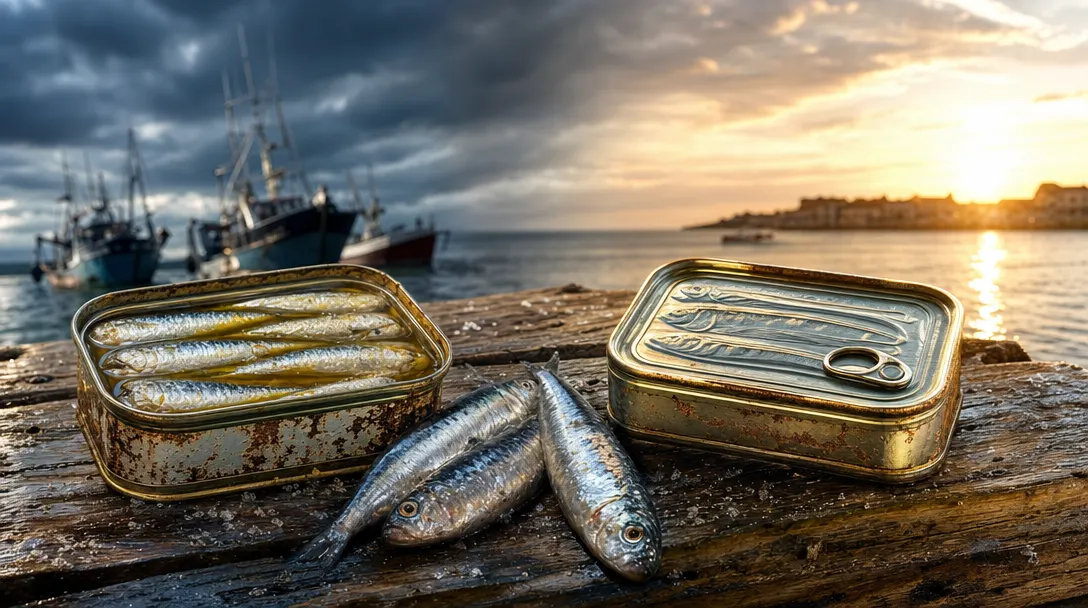
Two French towns have a particular claim on the sardine. One is Breton, shaped by the memory of a working port and the cold waters off Finistère. The other is in the Vendée, known for a certified fishery and remarkable freshness. Learning to tell their tins apart is a good step from simply enjoying sardines to really knowing them, much as a wine lover learns to tell two neighbouring villages apart.
Two ports, two characters
The sardine travels, but it lives in the water it passes through, and the coast changes between Finistère and the Vendée.
Douarnenez sits on a deep bay in western Finistère, opening towards the Iroise Sea and the open Atlantic. For centuries its waters supported large shoals and an entire economy built on them.
Saint-Gilles-Croix-de-Vie lies further south, on the gentler coast of the Vendée. According to the town's tourist office, sardines are landed there between April and the beginning of October, the season in which the fish builds up its fat.
Season matters as much as place. The month of the catch decides how fat the fish is, and so how it will age in oil; the article on the sardine season in Brittany explains why.
One honest caveat: no study has compared the fat or flavour of sardines from the two ports. The differences people describe come from origin, season, freshness and each cannery's way of working, read by the palate rather than measured in a laboratory.
Douarnenez: the cradle of the Penn Sardin
Douarnenez is not a folk backdrop. It was a real industrial port. According to the Port-Musée de Douarnenez, it was Brittany's largest sardine port in the early twentieth century, with almost 800 boats, around a quarter of the Breton fleet, and 4,560 registered seamen in 1910 in a town of about 15,000 people.
Behind the boats stood the canneries and the women who worked in them, the Penn Sardin, named after their headdress. They sorted, gutted and packed the fish, and in the early twentieth century they went on strike for fair pay, a fight Brittany's tourism board still remembers as a symbol of women's rights.
Douarnenez is also where Connétable began in 1853; the house describes itself as the oldest sardine cannery in the world. Today the town's heritage can be followed on foot, from the museum to the quays.
Vintage tins still carry the town's name. In the collection presented on this site, the Pointe de Penmarc'h house in Douarnenez makes old-style vintage sardines, each year illustrated by a Breton artist: Marianne Larvol, who lives and works in Douarnenez, for 2020; the painter and sculptor Fañch Moal for 2021; Bruno Blouch and Erika Raïo for 2022.
Saint-Gilles-Croix-de-Vie: Label Rouge and freshness
The Vendée tells a more recent story, built on certified quality and speed.
The tourist office gives the figures: close to 2,900 tonnes of sardines landed each year; fish at the auction within twelve hours of leaving the water, then processed within twenty-four hours nearby. The local sardine was the first wild fish to be awarded the Label Rouge, and sardine fishing in Saint-Gilles-Croix-de-Vie is listed as Intangible Cultural Heritage of France.
Canning there now happens at the last cannery still working in the town, the Conserverie Gendreau, opened in 1887 and run by the Gendreau family since the early twentieth century. Its brand, La Perle des Dieux, cans its vintage sardines in extra virgin olive oil and invites artists to illustrate them: Coralie Joulin's Mademoiselle Lulu, Delphine Cossais's Mademoiselle Perle, or Justine Sage's fisherman watching over the reef with the Tour Joséphine lighthouse behind him. The house advises turning tins every six months and, for some vintages, waiting three to four years before opening.
Know the port, not only the country
"Made in France" says little on its own. A tin from Douarnenez and a tin from Saint-Gilles-Croix-de-Vie share a country and an ocean, yet they come from different waters, different seasons and different hands. Reading the port on the label is like reading the village on a bottle of Burgundy: it tells you where to look for the story.
| Douarnenez | Saint-Gilles-Croix-de-Vie | |
|---|---|---|
| Region | Finistère, Brittany | Vendée |
| Waters | Deep bay open to the Iroise Sea | Gentler Vendée coast |
| Heritage | Brittany's great sardine port, the Penn Sardin | First wild fish under Label Rouge, listed fishing |
| Houses in the collection | Pointe de Penmarc'h | La Perle des Dieux |
For travellers who want to see both, the article on visiting the canneries of Brittany and the Atlantic coast suggests where to go.
A tasting, port against port
The best way to settle the duel is at the table. Choose two vintage tins in olive oil, one from each port, ideally from the same year. Open them together, at room temperature, with plain bread.
Taste the oil first, then the flesh. Note the firmness, the salt, the depth, how far the bones have melted. You may find one more briny and direct, the other rounder; you may find the year matters more than the port. Either way, you will have learnt to read the tin.
Neither town needs to win. The French sardine is richer for having both.
From the collection
Gilbert Shelton · 10 tins · Shelf I
Marianne Larvol · 5 tins · Shelf I